


In the village of Aburi-Amanfo, the morning mist did not merely cling to the hills; it felt like a heavy shroud of ancestral secrets. For three generations, the Agbedu and Donkor families had lived on opposite sides of the Densu River, separated by a blood feud so ancient that even the oldest linguists at the Chief’s palace struggled to recall its origin. To an outsider, the village was a lush paradise of emerald cocoa trees and vibrant kente looms; to the locals, it was a minefield of grudges where a single stray word could ignite a war.
The Forbidden Bloom
Kofi Agbedu was a man of the earth, his skin the color of dark chocolate, his hands permanently stained with the juices of the cocoa pods he harvested with religious devotion. He was the eldest son of the Agbedu clan, expected to carry the mantle of their family’s pride and their family’s hate. His father, Opanin Agbedu, was a man of rigid principles who often said that the water of the Densu was poisoned the moment it touched a Donkor’s shadow.
Across the water lived Ama Donkor. She was a seamstress whose patterns were said to capture the very rhythm of the highlife music that drifted from the local drinking spots on Friday nights. She was grace personified, with a laugh that could make the most cynical elder crack a smile. But her life was governed by the same invisible walls that restricted Kofi. Her father, Opanin Donkor, had spent decades nurturing a bitterness that was as deep as the river itself.
The love began at the river—the forbidden boundary. It started on a Tuesday, the day of the earth goddess, Asase Yaa, when the village was supposed to rest. Ama’s colorful thread had fallen into the water and floated toward the Agbedu side. Kofi, washing his face after a long day, caught the silk. When he looked up and saw Ama standing on the opposite bank, the world seemed to tilt.
“If my father saw me here, he would bury my sewing machine and me along with it,” Ama whispered weeks later, her voice trembling as the sun dipped behind the silk cotton trees.
Kofi took her hand across the narrowest point of the stream. “And if my brothers saw us, they would turn this river red. But Ama, your face is the only peace I find. Every time I see a Donkor, I am told to feel hate. But when I see you, I only feel a hollow in my chest that needs filling.”
Their love was a delicate architecture of stolen glances and coded messages sent through trusted children. It was built on a foundation of profound respect—not just for each other, but for the weight of their family names. They didn’t want to elope; they wanted to belong.
The Shadow of Suspense and Confusion
The confusion began when the village priestess, Nana Adjoa, made a prophecy during the Akwasidae festival. She stood in the center of the clearing, her eyes rolling back, her body trembling with a force that seemed to shake the very ground.
“Two roots from poisoned soil have entwined!” she shrieked. “A fruit is coming that will break the stool or mend the land. But the fruit will not look like the tree, and the tree will not recognize its own sap!”
The village buzzed with suspense. Rumors spread like a brushfire. The Agbedus suspected the Donkors of practicing dark medicine to steal their land; the Donkors suspected the Agbedus of poisoning the communal wells. The tension reached a breaking point when Kofi and Ama’s secret was finally unearthed. Ama’s father found a strip of Agbedu-woven cloth in her room. The fallout was immediate. Kofi was beaten by his own kin, and Ama was locked in her room, the door barred with mahogany planks.
But the prophecy was already in motion. Ama was pregnant, carrying a life that belonged to both sides of the divide.
The Night of the Great Storm
Nine months later, a storm hit Aburi-Amanfo that turned the Densu River into a raging beast, swallowing the bridge that connected the two sides. In the heat of the storm, Ama went into labor. Because the river was impassable, the Donkors could not reach the midwife on the Agbedu side. Ama was losing strength, and the village healers were baffled.
Driven by a desperate love, Kofi tied a rope to a massive baobab tree and threw himself into the churning waters. He nearly drowned, but he reached the other side. He broke down the door to Ama’s room, not with violence, but with the strength of a man who had nothing left to lose.
When the child was finally born as the first light of dawn broke, a heavy, suffocating silence fell over the room.
The Birth of Nyame-Kaye
The boy was named Nyame-Kaye (God Remembers). However, the joy was replaced by a profound confusion. Nyame-Kaye was born with legs that were thin and twisted, bent in a way that suggested he would never stand.
“He is broken,” Opanin Donkor whispered with shame. “He is a curse,” Kofi’s father added, standing at the doorway after the waters subsided.
For three years, Nyame-Kaye was a shadow in the village. He did not speak. He did not cry. He simply crawled through the dirt, his eyes wide and unnervingly wise. He observed the families as they continued to bicker over land boundaries. The families remained divided, though a tentative truce existed for the sake of the child.
The Supernatural Resolution
The resolution came during the Great Drought of 2026. The cocoa pods shriveled, and the yams were nothing but dust. The Agbedus and Donkors were at each other’s throats again, each accusing the other of hoarding what little water remained.
One afternoon, a violent argument erupted in the village square. Opanin Donkor and the Agbedu patriarch were shouting, their hands on their machetes. In the midst of this chaos, Nyame-Kaye crawled into the center. He was four years old, with his twisted legs tucked beneath him.
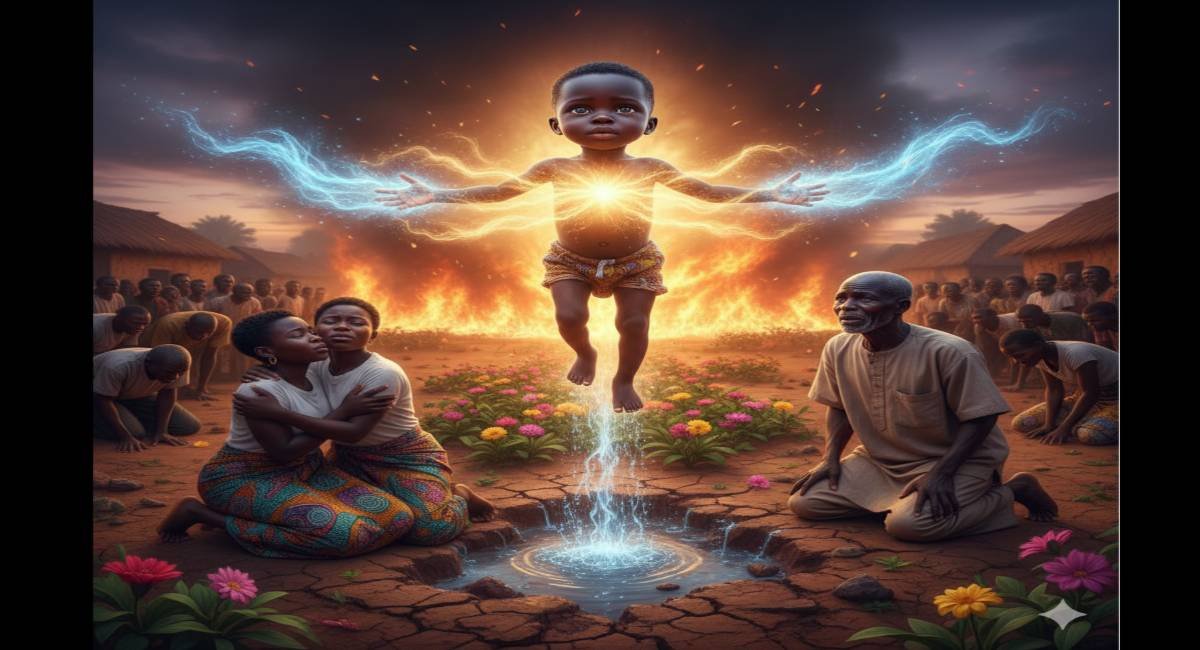
Suddenly, he didn’t just crawl; he floated.
A gasp ripped through the crowd. The boy rose three feet into the air. A golden light began to emanate from his chest. His eyes glowed with an electric intensity.
For the first time, Nyame-Kaye spoke. His voice was a resonant, melodic harmony. “The land does not belong to the Agbedu. The land does not belong to the Donkor. The land belongs to those who cherish it together. You fight over the skin of the earth while the soul of the village dies.”
He reached out his small hands and touched the foreheads of both grandfathers. In that instant, both men were flooded with the memories of the other—the hardships, the losses, and the shared love for the same soil.
As the boy’s feet—still twisted, yet now seemingly sacred—touched the ground, the sky cracked open. A torrential rain began to fall.
The Great Bond
The families fell to their knees in the mud. The confusion that had clouded their minds for generations evaporated. They saw Nyame-Kaye not as “physically challenged,” but as a bridge. His physical difference was the very thing that had forced the village to slow down and look closer at what truly mattered.
Kofi and Ama stood together, holding their son. The Agbedus and Donkors merged. They tore down the fences and shared the harvest. The village of Aburi-Amanfo became a place of legend, where the “Boy of the Golden Light” lived as a reminder that the greatest power on earth is not the strength of one’s legs, but the reach of one’s heart.
The feud was dead. In its place grew a love and bond that was, quite literally, grounded in the miraculous.
10 Moral Lessons
- Love Transcends Boundaries: True affection like Kofi and Ama’s can bridge any gap, regardless of ancestral history.
- Hatred is an Inherited Ghost: We often carry the grudges of our forefathers without understanding why, causing unnecessary suffering.
- Perspective Overcomes Confusion: Misunderstandings often arise from a lack of empathy; seeing through another’s eyes can resolve decades of conflict.
- Strength is Not Always Physical: Nyame-Kaye’s “disability” proved to be his greatest strength, teaching that value is not defined by physical perfection.
- Nature Demands Unity: The drought and storm served as reminders that environmental survival requires communal effort, not individual greed.
- Respect for the Supernatural: The villagers learned that divine signs often come in forms we least expect or initially reject.
- The Destructiveness of Pride: The patriarchs’ refusal to back down almost led to the village’s ruin, showing that ego is a barrier to prosperity.
- Children as Peacemakers: The innocence and purity of the next generation can often heal the cynicism of the old.
- Stewardship of the Land: Wealth comes from the soil, but the soil only flourishes when tended to by a united people.
- The Power of Forgiveness: Letting go of the past is the only way to build a sustainable and peaceful future.
Join the Intelligence Network
Join HeadlineX Now
HeadlineX Official
HeadlineX Official is the primary editorial desk for the HeadlineX network, dedicated to delivering verified intelligence, real-time news alerts, and high-impact investigative reporting. As the backbone of the network’s editorial integrity, this profile ensures that every story meets the highest standards of accuracy and speed for our global audience.